The "Walk for Lika" protest goes beyond the specific case of Gospić, it exposes a systemic waste management crisis!
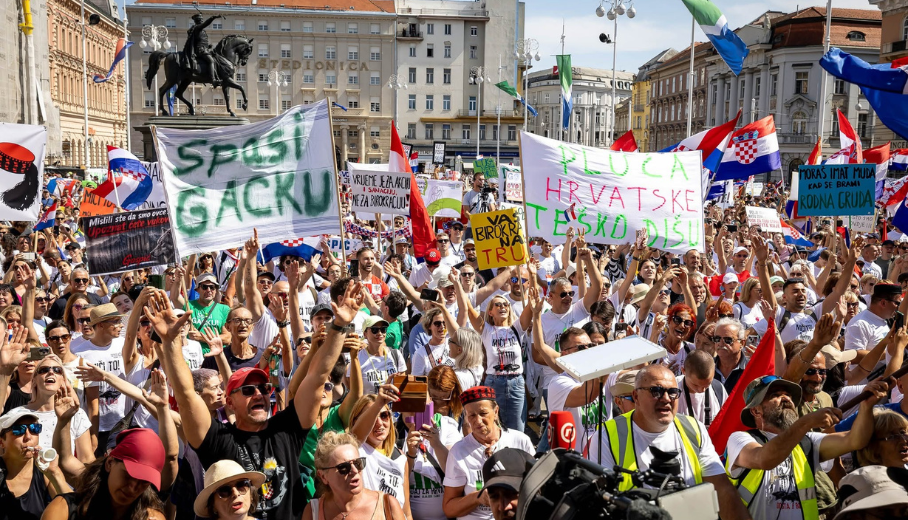
As one of the largest demonstrations in modern Croatian history, the protest held under the slogan “Walk for Lika, walk for Croatia!”, and organized by the civic initiative “Gospić is Our Home”, brought together approximately 30,000 people from across the country. Citizens recognized that this is not merely a local issue for Gospić, but a systemic failure that directly impacts us all. They gathered to demand their fundamental right to a clean and healthy environment as a prerequisite for the health of present and future generations.
Zelena akcija proudly joined the rally, contributing with a speech and a clear message: the state and its institutions are directly responsible for the hazardous waste crisis in Croatia! In Gospić, authorities knowingly permitted the import of hazardous waste that cannot legally be disposed of. This enabled private individuals to profit at the public’s expense, leaving taxpayers to foot the bill for damage and remediation. Instead of cleanups, these funds should have been invested in modernizing infrastructure: building sorting facilities, advanced composting plants, and reuse centers to bring order to the chaos of waste management at local, county, and national levels.
Legal landfills like Jakuševec and Karepovac, alongside regional waste management centers (whether operational or planned, such as Marišćina, Kaštijun, Piškornica, and Resnik), have burdened the environment for years. Together with partner initiatives, we point this out constantly. Still, these operational flaws are nothing compared to illegal imports and state-sponsored waste dumping. In Gospić, this was enabled by a former Minister of Environmental Protection, while the Chief State Inspector took bribes and looked the other way, and the Prime Minister claimed total ignorance. This pressure from citizens will force the Government to finally step in and resolve the issue in Gospić.
Failed remediations of the past
It is critical to closely monitor how the Gospić cleanup is handled. Over the past few decades, Croatia has failed to sustainably remediate a single major “black spot”—hazardous waste sites that remain unresolved for decades.
A few clear examples:
- Salonit Vranjic: the factory was shut down in 2006, yet local residents continue to fall ill and die from rare forms of cancer.
- Factory in Dugi Rat: closed back in 2000, yet hazardous waste remains abandoned on site.
- Crno Brdo in Biljane Donje: currently undergoing a deeply flawed remediation process; relocated waste was left exposed to sun, rain, and wind in Sisak, allowing toxic compounds to leach into the soil and the Kupa and Sava rivers.
Will state institutions uphold high environmental and social standards during the Gospić cleanup, or will they repeat old patterns by shifting waste to another community, exporting it, or burning it?
What should sustainable remediation look like?
The solution for illegally dumped waste must not involve thermal recovery—whether through incineration, pyrolysis, plasma, or related technologies. Falsely presented as safe and clean, these processes actually emit vast quantities of harmful pollutants like dioxins, furans, and carbon dioxide, directly driving climate change. They also create dangerous byproducts, including toxic ash and slag full of heavy metals.
A truly sustainable remediation strategy includes:
- detailed mechanical sorting of waste
- neutralization of hazardous properties (such as through steam sterilization).
- maximum material recovery to create new products or raw materials for secondary industries (construction, metallurgy, roadworks)
- safe disposal of the minimal, non-reusable inert residue in legal landfills.
Root causes of systemic chaos: Where does the waste come from?
Even after Gospić is cleaned up, deep systemic problems will remain, allowing new “black spots” to emerge. The waste disposal system—particularly for plastic, hazardous, and construction waste—is full of irregularities tolerated by authorities, mostly through the lax oversight of the State Inspectorate and the Ministry of Environmental Protection and Green Transition.
Key systemic failures:
- Lack of border controls on waste transport: a significant portion of this waste was imported from abroad. Border checks were severely weakened in 2019 and 2021 by decisions of former Minister Tomislav Ćorić. By eliminating the requirement to announce shipments three days prior to arrival and scrapping the Special Register for non-hazardous waste, cross-border transport lost its primary filter. Criminal networks use this loophole to mislabel hazardous waste and import it unchecked.
- Flawed permitting criteria: the ministry issues waste management permits to companies without conducting physical site inspections. This leads to massive waste accumulation and processing in unsafe conditions. The plant in Vrginmost is a clear example: for years, its plastic processing facility jeopardized the health and quality of life of local residents. It was shut down only after heavy pressure from the community and Zelena akcija. Yet here too, waste was imported from abroad, no one was held criminally liable, and the site remains unremediated.
“Black spots” across Croatia
Numerous sites across the country where waste was illegally dumped or buried still await cleanup. The most critical locations in and around Zagreb:
- Ježdovec forest: tens of thousands of tons of buried waste.
- Savica lakes: over 40 years ago, 50 barrels of fuel oil and tar were dumped here.
- Kosnica: an estimated hundreds of thousands of tons of waste sit directly above a vital drinking water source.
- Žitnjak: an industrial complex where the company E-Kolektor abandoned over 10,000 tons of waste following its bankruptcy.
Other prominent examples across Croatia:
- Jama Sovjak (near Rijeka): over 40,000 tons of hazardous industrial waste.
- Gospić: over 37,000 tons.
- Poznanovec: over 13,000 tons.
- Benkovac: over 11,000 tons.
- Vrbovec Samoborski: around 8,000 tons.
- Varaždin: around 5,000 tons.
- Pazin: around 4,000 tons.
- Lovinac: over 3,000 tons.
- Senj: around 2,600 tons.
Remediation and penalizing polluters are measures that come at the very end of a destructive chain—after waste has already been generated, imported, and dumped into the environment. High corruption rates and weak controls have turned Croatia into a haven for illegal waste from across Europe. Zelena akcija therefore demands the immediate cleanup of all sites, harsher penalties, and compensation for affected communities—but above all, a fundamental overhaul of the system. We demand strict criteria for permit issuance and continuous oversight of waste transport and disposal so that threats to public health and the environment are prevented in the first place.